Proudly sponsored by Hilo Home Inspection LLC — safeguarding Big Island homes with Aloha.

Fireworks in Hawaiʻi: Legal on Paper, Dangerous in Reality
Fireworks in Hawaiʻi are legal only under very limited conditions, yet they are widely misused every year. This article explains what the law actually allows, what is illegal, and why public safety concerns increased after the New Year 2024/2025 tragedy.
LOCAL VOICES
Public Safety & Community Awareness
12/29/20252 min read


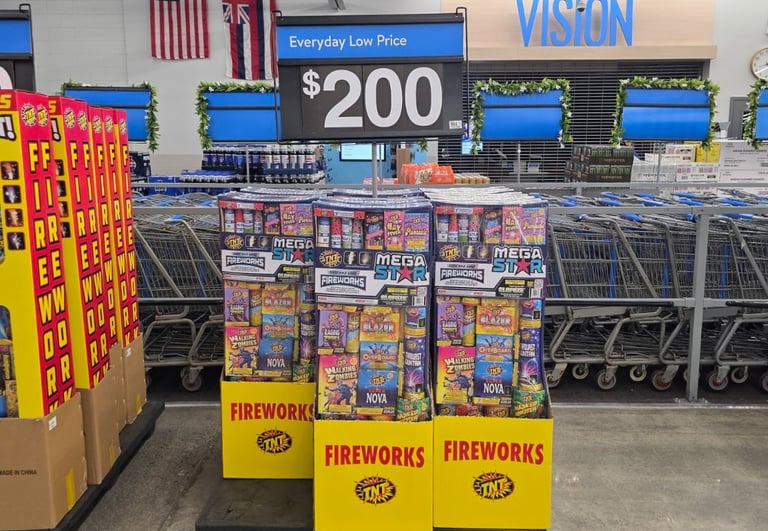
Walk into a big-box store in Hawaiʻi during the holidays and you’ll see it clearly:
$200 and $300 fireworks packages stacked high, marketed as “Everyday Low Price.”
To many people, this looks like normal holiday tradition.
But the reality in Hawaiʻi is far more complicated — and far more dangerous.
What Fireworks Are Actually Legal in Hawaiʻi
Under Hawaiʻi law, most fireworks are illegal.
What is allowed is extremely limited:
Only consumer fireworks (small fountains, sparklers, novelty items)
Only with a permit
Only during a short window:
December 28–31
July 1–4
Only at approved locations
Aerial fireworks are illegal for the public at all times
Anything that launches into the air, explodes loudly, or travels is not legal for civilian use.
The Gap Between Law and Reality
Here is the uncomfortable truth:
Fireworks are sold openly, in bulk, and in high-dollar packages — while enforcement remains weak.
This creates a dangerous illusion:
“If it’s sold in the store, it must be legal.”
That assumption is wrong.
Many of the fireworks sold are:
Misused
Combined
Modified
Or transported illegally after purchase
Once they leave the store, control disappears.
What Changed After New Year 2024/2025
New Year’s 2024/2025 marked a turning point.
A family was killed in a fireworks-related incident — a tragedy that shocked the entire state.
This was not “celebration gone wrong.”
It was a predictable outcome of:
Illegal aerial fireworks
Explosives used in residential areas
Lack of enforcement
Normalization of dangerous behavior
After this incident:
Lawmakers renewed calls for stricter enforcement
Police departments increased post-holiday crackdowns
Public tolerance for fireworks misuse dropped sharply
The law itself did not suddenly change — but the consequences became real and undeniable.
Why Fireworks Are Especially Dangerous in Hawaiʻi
Hawaiʻi is not built like mainland cities.
We have:
Dense residential neighborhoods
Wooden homes
Dry vegetation
Trade winds
Narrow roads
Elderly residents
Children sleeping nearby
One firework in the wrong place can:
Start a house fire
Burn an entire neighborhood
Cause permanent injury
Kill innocent people
This is not hypothetical. It already happened.
The Cost No One Talks About
Fireworks don’t just explode in the sky.
They also explode in:
Emergency rooms
Fire department budgets
Police overtime
Insurance premiums
Trauma for families and first responders
Those costs are paid by everyone, including people who never lit a single fuse.
Why the Law Exists
Fireworks laws in Hawaiʻi are not about banning joy.
They exist because:
Fireworks are explosives
Explosives don’t mix with residential living
The risk far outweighs the momentary thrill
Professional fireworks displays are handled by trained crews, controlled zones, and safety planning.
Backyard fireworks are not professional displays, yet permits are routinely granted to non-professionals.
A Moment for Honest Reflection
This is not about pointing fingers.
It’s about asking one hard question:
Is a few seconds of noise and light worth a human life?
After New Year 2024/2025, that question is no longer abstract.
Final Thought
Fireworks in Hawaiʻi exist in a strange space:
Legally restricted
Commercially normalized
Socially tolerated
Publicly dangerous
Until enforcement matches reality — or behavior changes — tragedies will repeat.
Celebration should never come at the cost of someone else’s life.
🌺
Ohana Big Island
For safety. For responsibility. For our future.
Disclaimer ::: This article is provided for public awareness and informational purposes only. It does not constitute legal advice. Fireworks laws and enforcement may vary by county and circumstance. Readers are encouraged to consult official State of Hawaiʻi or county sources for the most current regulations and permit requirements.
Photo taken in a Hawaiʻi retail store for news and public awareness purposes.
Connect
Where island hearts connect and grow.
Contact
ohanabigisland808@gmail.com
Hawaii Web Pro LLC © 2025. All rights reserved.
RISK WARNING & NOTICE ::: All content shared on Ohana Big Island is for educational and informational purposes only. It is not professional, legal, medical, agricultural, or technical advice. Always seek guidance from a qualified and certified professional before making decisions or taking action based on any information found on this website or its related platforms. Your safety, property, and well-being deserve verified expertise.